
(See My Weekly Wisdom Column of April 25, 2009 – Go Green!)
Okay, you’ve finally convinced me that global warming really does exist. We really do need to do everything we can to conserve energy and develop new green technology to save Mother Earth.
I am going to propose some radical steps that we should have taken long ago. I don’t have any hard facts to back up the energy waste, or in this case, the savings. However, I have seen some of the statistics that others use to justify the use of the new CFC light bulbs. I have read that we waste huge amounts of energy and spew tons and tons of carbon into our atmosphere merely by leaving our computers and television sets running 24/7—albeit in “sleep” mode.
Now I have thought of two other wastes of power with the attendant spillage of carbon into our fragile environment. Here they are.
First, we have to stop broadcasting late night TV. Shows like The Tonight Show, Late Night with whoever replaced Conan O’Brien, Jimmy Kimmel Live. And all those hardcore and softcore pornography films that always seem to be shown late at night have to go. It not only wastes tons of electricity, but it also pollutes our airwaves with a lot of filth.
I suggest that we go back to a format for all stations where they play the National Anthem of whichever country originates the broadcast, and put that wonderfully nostalgic “test pattern” back on immediately after the local nightly news, sports and weather. That stays on for five minutes and then it’s “Nighty-night.”
Just think of all the electricity we would save be limiting broadcasting to 18 hours a day instead of the present 24/7.
Now, if you enjoy the late night shows–and I guess a lot of us do–then I say they put them on earlier in the evening so we can all enjoy them. After all, we all wax nostalgic over the earlier generation of television shows, like “The Ed Sullivan Show,” “Your Show of Shows,” “Texaco Star Theater,” “The Colgate Comedy Hour” and many more. They used the same theme as these modern-day late night shows, and everybody loved them. Let’s get them back!
My second proposal is even better than the first. It not only will save precious fuel, but will also get rid of some pretty obnoxious people and plots. It ties in with the first proposal, too.
We have to give up movies!
Well, maybe not all movies, but how about we stop making “B-grade” films. That would eliminate about ninety percent of the junk that is shown these days. If a film is really good, it could be produced as a DVD or Blue Ray film and sold in stores immediately upon release. The tendency is to do just that about two months after they hit the theaters anyway.
Some of the more controversial movies, horror flicks and chick flicks and other genres, seem to become boring after about an hour, so why not produce them for some of these rogue TV stations that show junk and old reruns now? (Nothing past 11:30 PM though) Producers should be able to limit the length to one hour by editing and cutting out all the crap they currently include.
Taking away the large screen movie theater would not only give us a better class of films, but it would keep all those cars and SUVs and such off the roads at night. Home entertainment is the way of today, so nobody should be forced to drive to a theater and pay exorbitant rates to see a picture.
There is the added benefit of all the gasoline we can save. And there are a lot of second-rate actors that would have to work for a living instead of giving us their poor performances.
Just think! We can actually bring back the “good old days” at the same time we conserve on energy and save the planet by putting my two proposals into effect. We might even change the moral tone of our society too.
Saturday, September 11, 2010

Saturday, September 4, 2010
Strange Coincidences
We are now back home in Augusta after our 13-day, 5,600-mile, 15-state trip. No, we didn’t get to do all the activities I had planned, but we did at least two that were not on the itinerary, the Wyler Aerial Tramway in El Paso, and the Civil War Battlefield in Vicksburg, Mississippi.
I do have a few reflections on the trip, things I learned and strange coincidences.
I found a town that I don’t think I could live in, Springdale, Utah. It is completely surrounded by towering cliffs. I don’t know the height of them, but I figure it is about 1,500 feet, and they are pretty much straight up. If you ever want to feel claustrophobic, just go to Springdale. It is also the western entrance to Zion Canyon, so it gives a pretty good preview of what you will see in the park
I learned at Vicksburg that the city was surrendered to General Grant on the 4th of July in 1863. That just happens to be the exact day Gettysburg was successfully defended by the Army of the Potomac under General Mead. That was a crushing blow to the Confederate Army, even though there was no communication in those days that would have conveyed the results between those diverse combat units. Being a Civil War history buff, I should have known those facts, but I confess that I didn’t know until I visited Vicksburg.
Some of the strange occurrences that we encountered:
1. Way up on Mount Evans in Colorado I followed a car with a Ray Laks license plate holder. I approached the driver in the parking lot at the summit and learned that he was from Western New York where I grew up.
2. In Kanab Utah at the Comfort Inn, the desk clerk said she was from New York. It turned out that she grew up in a neighboring town to the one where I grew up.
3. We had several library books downloaded on my MP3 player. The setting for one was the Leelanau Peninsula of Michigan, where I had been on my last trip in June.
4. Another book on my MP3 was set in a fictional town in Columbia County, Georgia, where I currently live. We had no idea that these fictional books were set in those places, but it made listening a lot more interesting.
5. When we stopped for the night at a motel in Capitol Reef National Park, there was a panel truck with Kentucky plates parked next to us. The truck had signage on the side reading, “Cumberland Lake Boat Movers.” Cumberland Lake, Kentucky was another one of the places I visited on the trip to Michigan.
It always amazes me when I find points of convergence in faraway places, so these five chance events were kind of stunning.
A couple of other facts about the trip:
I tried to keep track of our expenditures for gasoline, but I lost track after a few days. I do know that we only paid over $3/gallon once in Torrey, Utah ($3.39 for regular), but most of the time, gas was around $2.75, and we did get it once for $2.39.
Our hotels cost just under $900, but we did use two reward nights. I do have to admit that some of our hotels were less than desirable, but we did stay at a couple that were first class, too.
My Golden Eagle pass was great, as it got us free admission to all national parks, of which we visited ten. If you take a trip like this one and are not old enough (62) to buy the Golden Eagle pass, at least purchase the annual pass for $80. It will pay for itself when you get to your 4th park or monument.
Our entire 13-day trip cost us under $2,000, and that’s pretty good, considering how much we saw and did.
For those of you to whom I sent the daily trip journals and pictures, I hope you enjoyed them, and felt like you were experiencing the same sights with us. For those who didn’t participate, let me know if you would like to see them, and I’ll send them along via email. There are nine days worth, and I think they came out very nicely.
I do have a few reflections on the trip, things I learned and strange coincidences.
I found a town that I don’t think I could live in, Springdale, Utah. It is completely surrounded by towering cliffs. I don’t know the height of them, but I figure it is about 1,500 feet, and they are pretty much straight up. If you ever want to feel claustrophobic, just go to Springdale. It is also the western entrance to Zion Canyon, so it gives a pretty good preview of what you will see in the park
I learned at Vicksburg that the city was surrendered to General Grant on the 4th of July in 1863. That just happens to be the exact day Gettysburg was successfully defended by the Army of the Potomac under General Mead. That was a crushing blow to the Confederate Army, even though there was no communication in those days that would have conveyed the results between those diverse combat units. Being a Civil War history buff, I should have known those facts, but I confess that I didn’t know until I visited Vicksburg.
Some of the strange occurrences that we encountered:
1. Way up on Mount Evans in Colorado I followed a car with a Ray Laks license plate holder. I approached the driver in the parking lot at the summit and learned that he was from Western New York where I grew up.
2. In Kanab Utah at the Comfort Inn, the desk clerk said she was from New York. It turned out that she grew up in a neighboring town to the one where I grew up.
3. We had several library books downloaded on my MP3 player. The setting for one was the Leelanau Peninsula of Michigan, where I had been on my last trip in June.
4. Another book on my MP3 was set in a fictional town in Columbia County, Georgia, where I currently live. We had no idea that these fictional books were set in those places, but it made listening a lot more interesting.
5. When we stopped for the night at a motel in Capitol Reef National Park, there was a panel truck with Kentucky plates parked next to us. The truck had signage on the side reading, “Cumberland Lake Boat Movers.” Cumberland Lake, Kentucky was another one of the places I visited on the trip to Michigan.
It always amazes me when I find points of convergence in faraway places, so these five chance events were kind of stunning.
A couple of other facts about the trip:
I tried to keep track of our expenditures for gasoline, but I lost track after a few days. I do know that we only paid over $3/gallon once in Torrey, Utah ($3.39 for regular), but most of the time, gas was around $2.75, and we did get it once for $2.39.
Our hotels cost just under $900, but we did use two reward nights. I do have to admit that some of our hotels were less than desirable, but we did stay at a couple that were first class, too.
My Golden Eagle pass was great, as it got us free admission to all national parks, of which we visited ten. If you take a trip like this one and are not old enough (62) to buy the Golden Eagle pass, at least purchase the annual pass for $80. It will pay for itself when you get to your 4th park or monument.
Our entire 13-day trip cost us under $2,000, and that’s pretty good, considering how much we saw and did.
For those of you to whom I sent the daily trip journals and pictures, I hope you enjoyed them, and felt like you were experiencing the same sights with us. For those who didn’t participate, let me know if you would like to see them, and I’ll send them along via email. There are nine days worth, and I think they came out very nicely.
Saturday, August 28, 2010
Great Tips for Corn on the Cob
I almost let this one get by me, but it is still timely, because I saw again today that corn on the cob is selling for 33 cents an ear. The suggestions I am presenting are from two sources. The first comes directly from The Rachel Ray Show on Food Network. And the second is from my daughter-in-law.
It is barbeque season again—at least it is here in Georgia—and most of us can’t wait to fire up the grill and cook outside on the patio. Among the side dishes we all enjoy is that perennial favorite, corn on the cob. I love it, but I always felt guilty about slathering all that butter on it. It was not an easy task to butter up an ear of corn either. The butter migrates to the bottom of the ear and falls off before it can melt in.
There is an alternative that you can use to your heart’s content, and it will most likely be a lot healthier for you than butter or even butter substitutes. I'll get to that in a moment, but first I have some preparation tips for the corn shucker.
When you’re ready to shuck the corn—some markets will let you do it in-store and provide a trash barrel for you to discard the greens—get yourself a rubber band to perform the task you always hated to do, getting rid of the corn silk that clings to the kernels after shucking.
Twist the rubber band once or twice and loop it between your thumb and index finger. Holding the ear of corn straight up, slide the twisted rubber band vigorously up and down while turning the ear. It will pick up those stray threads of corn silk and remove them in no time. Voilá! You have a clean ear of corn and no silk to get in your teeth.
When you buy the ears of corn in the produce section of your market, pick up a lime or two. A good plan is to buy one lime for every two ears of corn. Try to get the standard limes about 2 inches in diameter, not key limes.
When you have shucked and roasted, boiled or microwave-heated your ears of corn and are ready to eat them, cut the limes in half. While squeezing the lime half vigorously, run it over the ear of corn while turning the ear. Make sure you see the juice running down into the kernels. Then add pepper and salt to taste and start munching.
You are going to be pleasantly surprised, because the limejuice is a great substitute for butter, enhances the corn taste and is a lot less messy. No more butter stains on your clothing, and it is oh, so much more healthy for you.
If you’re really economical, you can probably get enough juice from the lime to coat two ears per half, but limes aren’t that expensive; I paid 25 cents for the last one I bought.
Try these neat and healthy tips the next time you have corn on the cob, and I think you’ll thank me for it.
It is barbeque season again—at least it is here in Georgia—and most of us can’t wait to fire up the grill and cook outside on the patio. Among the side dishes we all enjoy is that perennial favorite, corn on the cob. I love it, but I always felt guilty about slathering all that butter on it. It was not an easy task to butter up an ear of corn either. The butter migrates to the bottom of the ear and falls off before it can melt in.
There is an alternative that you can use to your heart’s content, and it will most likely be a lot healthier for you than butter or even butter substitutes. I'll get to that in a moment, but first I have some preparation tips for the corn shucker.
When you’re ready to shuck the corn—some markets will let you do it in-store and provide a trash barrel for you to discard the greens—get yourself a rubber band to perform the task you always hated to do, getting rid of the corn silk that clings to the kernels after shucking.
Twist the rubber band once or twice and loop it between your thumb and index finger. Holding the ear of corn straight up, slide the twisted rubber band vigorously up and down while turning the ear. It will pick up those stray threads of corn silk and remove them in no time. Voilá! You have a clean ear of corn and no silk to get in your teeth.
When you buy the ears of corn in the produce section of your market, pick up a lime or two. A good plan is to buy one lime for every two ears of corn. Try to get the standard limes about 2 inches in diameter, not key limes.
When you have shucked and roasted, boiled or microwave-heated your ears of corn and are ready to eat them, cut the limes in half. While squeezing the lime half vigorously, run it over the ear of corn while turning the ear. Make sure you see the juice running down into the kernels. Then add pepper and salt to taste and start munching.
You are going to be pleasantly surprised, because the limejuice is a great substitute for butter, enhances the corn taste and is a lot less messy. No more butter stains on your clothing, and it is oh, so much more healthy for you.
If you’re really economical, you can probably get enough juice from the lime to coat two ears per half, but limes aren’t that expensive; I paid 25 cents for the last one I bought.
Try these neat and healthy tips the next time you have corn on the cob, and I think you’ll thank me for it.
Marshmallows
This week I visited an unusual farm. It was so unique and so incredible that I just had to share my experience with you. You see I went to a marshmallow farm.
I bet you thought, as I used to, that marshmallows were processed and made of sugars and corn syrups and stuff like that. But really, they are grown here in Grovetown in our famous marshes. That’s why they’re called marshmallows, of course. I never knew that.
The marshes in Grovetown are perfect for growing the marshmallow plant. They used to be mangrove swamps, hence the name “Grovetown.” When the mangrove trees died in a blight, the swamps were drained and the marshes remained with lots of nutrients and nitrogen, a great combination for growing the marshmallow plants.
What does a marshmallow plant look like? Well, you might think they would look like cotton plants, with little marshmallows on stalks that you harvest like tomatoes or, well, like cotton. But, oh no, they grow like pumpkins and squash. They grow real big, so big that you can only harvest one at a time.
The raw marshmallows have to be divided up into their smaller ones that you buy in the store. But that isn’t as difficult as it would seem. The big ones can be pulled apart into individual cells and dried out form those perfect little spheres you toast on a stick by the campfire. If left a while longer, the marshmallows shrink into the tiny ones we call mini-marshmallows, the ones you put into hot chocolate.
I didn’t get to see the harvest, because they aren’t quite ready, but that will take place in a few weeks, and then there will be the annual Marshmallow Festival, a whole weekend of celebrating and eating the sweet little things.
Now, about this time, you’re probably as skeptical as I was about the existence of these “marshmallow farms.” Well, I can understand that. Therefore, I took a picture of the marshmallows still growing in the field to prove they are genuine.
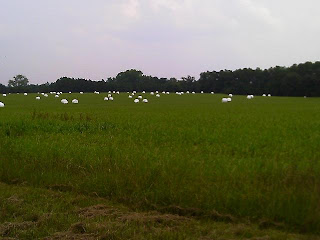
Do you believe now???
I bet you thought, as I used to, that marshmallows were processed and made of sugars and corn syrups and stuff like that. But really, they are grown here in Grovetown in our famous marshes. That’s why they’re called marshmallows, of course. I never knew that.
The marshes in Grovetown are perfect for growing the marshmallow plant. They used to be mangrove swamps, hence the name “Grovetown.” When the mangrove trees died in a blight, the swamps were drained and the marshes remained with lots of nutrients and nitrogen, a great combination for growing the marshmallow plants.
What does a marshmallow plant look like? Well, you might think they would look like cotton plants, with little marshmallows on stalks that you harvest like tomatoes or, well, like cotton. But, oh no, they grow like pumpkins and squash. They grow real big, so big that you can only harvest one at a time.
The raw marshmallows have to be divided up into their smaller ones that you buy in the store. But that isn’t as difficult as it would seem. The big ones can be pulled apart into individual cells and dried out form those perfect little spheres you toast on a stick by the campfire. If left a while longer, the marshmallows shrink into the tiny ones we call mini-marshmallows, the ones you put into hot chocolate.
I didn’t get to see the harvest, because they aren’t quite ready, but that will take place in a few weeks, and then there will be the annual Marshmallow Festival, a whole weekend of celebrating and eating the sweet little things.
Now, about this time, you’re probably as skeptical as I was about the existence of these “marshmallow farms.” Well, I can understand that. Therefore, I took a picture of the marshmallows still growing in the field to prove they are genuine.

Do you believe now???
Saturday, August 21, 2010
Dying Intestate
This week I am going to write about something that many (most?) people avoid. We are all alive for a limited time, and no one knows when his or her time is up. Yet we all seem reluctant to discuss and plan for our eventual demise.
I don’t know your financial situation, nor do I want to know it. Some of you might think you don’t have enough assets to have to make a will, so you might quit reading right here. However, just because you haven’t saved anything and don’t own very much, it is still possible that you have considerable “wealth.”
If you are employed, you likely have some form of group term life insurance through your employer. Most good companies provide at least an amount equal to two times your annual income free of charge with options to purchase more insurance at group rates.
If you own, or hold a mortgage or a loan on property, a house, a car, a boat, a motorcycle, then you probably have some form of life insurance on the balance you owe. Some credit card companies require that you have insurance on unpaid balances.
In short, there are many assets that you hold that only come into play upon your death, so you may be richer than you think you are. You had better not stop reading until you reach the end of the column.
Regardless of how much money, property or insurance you have accumulated, everyone needs some kind of a will. Even if you don’t own a lot, you should document what assets you want to go to each of your heirs when you die.
When there are children or multiple life partners—unfortunately, multi-marriage and multi-divorce have become a common experience—lack of a last will and testament are almost certain to cause feuds or lawsuits when a person dies.
If you die intestate—that means “without a valid will”—your property must pass through a process called probate. The court will decide who gets what, and it won’t necessarily be the person or persons whom you would have chosen.
For instance, if you are married and have children, regardless of their ages, and you die without executing a proper and legal will, your property will likely be divvied up in equal amounts among your wife and children. If the children are not at least 18-years-old (in some states, 21-years-old) the money will be held in trust and will not be available to your surviving spouse to help raise them.
In some cases, other relatives may inherit your assets, such as parents or siblings. Some of us would prefer that no assets go to certain people, but without a valid will the courts will decide in their favor. Oh yes, some of those assets will surely go to lawyers and others whom you never intended to receive it. That is what probate is all about.
Leaving aside the issues of property and insurance, a person who dies intestate leaves his or her children at the mercy of the courts. If both spouses die and no guardian has been designated in a will, the minor children become wards of the state. Children may be turned over to grandparents, aunts or uncles, but not necessarily according to your wishes.
If heirs are minor children of a former marriage, and the other natural parent is still alive, Absence of a valid will could entitle that parent to claim the children over the claim of the stepparent. Divorce is in and of itself a critical reason to have a will for all the same reasons given above.
After reading all of this, if you believe that none of this affects you, because you come from a long-lived family, think again. In this world, we could go at any time. Age and family history have nothing to do with it.
When I was younger, I sold life insurance, and we had a saying that we always quoted to our prospects: “Save like you’ll live to 100, but insure as though you’ll die tomorrow.” That applies to making a will just as much. Don’t let anything keep you from making a will to satisfy your wishes for your assets and care of dependents rather than letting some stranger decide for you.
It will probably cost you anywhere from a hundred to a thousand dollars to have a good will drawn up—on the low side if you don’t have a lot of assets—but it could save your heirs thousands of dollars in fees and taxes, and it will give you immediate and lasting peace of mind.
I don’t know your financial situation, nor do I want to know it. Some of you might think you don’t have enough assets to have to make a will, so you might quit reading right here. However, just because you haven’t saved anything and don’t own very much, it is still possible that you have considerable “wealth.”
If you are employed, you likely have some form of group term life insurance through your employer. Most good companies provide at least an amount equal to two times your annual income free of charge with options to purchase more insurance at group rates.
If you own, or hold a mortgage or a loan on property, a house, a car, a boat, a motorcycle, then you probably have some form of life insurance on the balance you owe. Some credit card companies require that you have insurance on unpaid balances.
In short, there are many assets that you hold that only come into play upon your death, so you may be richer than you think you are. You had better not stop reading until you reach the end of the column.
Regardless of how much money, property or insurance you have accumulated, everyone needs some kind of a will. Even if you don’t own a lot, you should document what assets you want to go to each of your heirs when you die.
When there are children or multiple life partners—unfortunately, multi-marriage and multi-divorce have become a common experience—lack of a last will and testament are almost certain to cause feuds or lawsuits when a person dies.
If you die intestate—that means “without a valid will”—your property must pass through a process called probate. The court will decide who gets what, and it won’t necessarily be the person or persons whom you would have chosen.
For instance, if you are married and have children, regardless of their ages, and you die without executing a proper and legal will, your property will likely be divvied up in equal amounts among your wife and children. If the children are not at least 18-years-old (in some states, 21-years-old) the money will be held in trust and will not be available to your surviving spouse to help raise them.
In some cases, other relatives may inherit your assets, such as parents or siblings. Some of us would prefer that no assets go to certain people, but without a valid will the courts will decide in their favor. Oh yes, some of those assets will surely go to lawyers and others whom you never intended to receive it. That is what probate is all about.
Leaving aside the issues of property and insurance, a person who dies intestate leaves his or her children at the mercy of the courts. If both spouses die and no guardian has been designated in a will, the minor children become wards of the state. Children may be turned over to grandparents, aunts or uncles, but not necessarily according to your wishes.
If heirs are minor children of a former marriage, and the other natural parent is still alive, Absence of a valid will could entitle that parent to claim the children over the claim of the stepparent. Divorce is in and of itself a critical reason to have a will for all the same reasons given above.
After reading all of this, if you believe that none of this affects you, because you come from a long-lived family, think again. In this world, we could go at any time. Age and family history have nothing to do with it.
When I was younger, I sold life insurance, and we had a saying that we always quoted to our prospects: “Save like you’ll live to 100, but insure as though you’ll die tomorrow.” That applies to making a will just as much. Don’t let anything keep you from making a will to satisfy your wishes for your assets and care of dependents rather than letting some stranger decide for you.
It will probably cost you anywhere from a hundred to a thousand dollars to have a good will drawn up—on the low side if you don’t have a lot of assets—but it could save your heirs thousands of dollars in fees and taxes, and it will give you immediate and lasting peace of mind.
Friday, August 6, 2010
Hands-Only CPR
It is time for me to repeat a column that I first published over two years ago, and one that is vitally important to me. The topic is Hands-only CPR.
I received a message from one of you over the weekend concerning a “new” method of performing cardio-pulmonary resuscitation (CPR), and while I already am familiar with the technique, it is apparently still unknown to some people.
Then I was watching some back episodes of the game show, Jeopardy! from my DVR player and one of the clues given by Alex Trebek concerned CPR. The clue as read was, “It calls for two breaths for every ten chest compressions.” It bothered me that Mr. Trebek was broadcasting the incorrect, outdated method for performing CPR to a huge television audience.
The combination of those two incidents in less than a week inspired me to revisit my column from April of 2008 and republish it this week. Since I am one of those people who carry the risk of sudden cardiac arrest, I cannot pass up the opportunity to enlighten as many potential lifesavers as possible. I hope you will spread the word too.
(Actually, I am not a candidate for CPR, because I now have an implanted cardiac device, called an ICD. It will kick in whenever my heart has several irregular beats, or when the natural pacemaker in my heart quits or fails to work properly. My condition is so critical that I cannot wait for lifesaving techniques to be applied.)
For those who are at less known risk, or those who have no medical history of cardiac problems, the chance of a cardiac event requiring CPR is currently about thirty percent. In other words, one out of every three of you will probably require CPR. That also means that another thirty percent will have occasion to administer it to someone else. And that someone else is quite likely to be someone you know and love, a family member. That being the case, it pays to know how and when to do it.
There has always been some aversion to performing CPR. The main reason is that it has always required both chest compressions and mouth-to-mouth breathing. Aside from the possibility of same sex administration, we all seem to have some reluctance to get up close and personal with strangers. That has lead to a lot of missed opportunity and delays in performing CPR.
When I learned CPR and became qualified in the 1970s, the procedure called for a 10/2 ratio of compressions to breaths if performing one-on-one. If two people were present, the ratio changed to 5/2, but either way, there was no way to keep an even rhythm. The one-on-one ratio was changed in the 1990s to 20/2, but it still wasted about 10-15 seconds to change positions and do the mouth-to-mouth. Those seconds were critical.
In actual experience, it was found that the stricken person tended to gasp during chest compressions, so some air was being inhaled even without mouth-to-mouth. Also, the lungs are never completely collapsed, so oxygenation of blood was not really an issue.
The hands-only CPR not only keeps a steady rhythm to the compressions, but it also removes the objectionable part of the procedures that has frequently prevented CPR from being performed. In my opinion, it will likely cause a much higher incidence of recovery from sudden cardiac events.
The new hands-only CPR requires the rescuer to perform continuous chest compressions at a rate of 100 per minute. That compares to a rate of 30-40 compressions per minute with an irregular rhythm in the former CPR technique. The survival rate is likely to go up with the new guidelines.
Hands-only CPR
If someone collapses, stops normal breathing and is unresponsive to shaking, here are the steps you should take:
· First, have someone call 911 and summon help, if a phone is handy.
· Put the person on the floor face up.
· Place one hand atop the other in the center of the person’s chest.
· Lock your elbows so that your arms are straight from shoulders to hands
· Push hard and fast, 100 compressions a minute.
· If there is another person with you, take turns. It is hard work.
· Continue compressions until paramedics arrive to take over.
(Source – American Heart Association)
If the person on whom you are performing CPR regains consciousness or shows signs of a return of heartbeat and breathing, you may quit your efforts, but do not move them and stay ready to begin again. Do not allow the victim to sit up, but make them as comfortable as possible.
There is a Website where you can learn more about hands-only CPR and even get some online training. Just click on the link here for the American Heart Association. Then be sure to read the links within that page. Other links can be found at the following sites, and the last among them actually provides some step-by-step training.
http://www.sfgate.com/cgi-bin/article.cgi?f=/c/a/2008/04/01/BAJ8VTF35.DTL
http://www.cbsnews.com/stories/2008/04/01/health/main3984803.shtml?source=RSSattr=HOME_3984803
http://medicine.arizona.edu/spotlight/learn-sarver-heart-centers-continuous-chest-compression-cpr
I received a message from one of you over the weekend concerning a “new” method of performing cardio-pulmonary resuscitation (CPR), and while I already am familiar with the technique, it is apparently still unknown to some people.
Then I was watching some back episodes of the game show, Jeopardy! from my DVR player and one of the clues given by Alex Trebek concerned CPR. The clue as read was, “It calls for two breaths for every ten chest compressions.” It bothered me that Mr. Trebek was broadcasting the incorrect, outdated method for performing CPR to a huge television audience.
The combination of those two incidents in less than a week inspired me to revisit my column from April of 2008 and republish it this week. Since I am one of those people who carry the risk of sudden cardiac arrest, I cannot pass up the opportunity to enlighten as many potential lifesavers as possible. I hope you will spread the word too.
(Actually, I am not a candidate for CPR, because I now have an implanted cardiac device, called an ICD. It will kick in whenever my heart has several irregular beats, or when the natural pacemaker in my heart quits or fails to work properly. My condition is so critical that I cannot wait for lifesaving techniques to be applied.)
For those who are at less known risk, or those who have no medical history of cardiac problems, the chance of a cardiac event requiring CPR is currently about thirty percent. In other words, one out of every three of you will probably require CPR. That also means that another thirty percent will have occasion to administer it to someone else. And that someone else is quite likely to be someone you know and love, a family member. That being the case, it pays to know how and when to do it.
There has always been some aversion to performing CPR. The main reason is that it has always required both chest compressions and mouth-to-mouth breathing. Aside from the possibility of same sex administration, we all seem to have some reluctance to get up close and personal with strangers. That has lead to a lot of missed opportunity and delays in performing CPR.
When I learned CPR and became qualified in the 1970s, the procedure called for a 10/2 ratio of compressions to breaths if performing one-on-one. If two people were present, the ratio changed to 5/2, but either way, there was no way to keep an even rhythm. The one-on-one ratio was changed in the 1990s to 20/2, but it still wasted about 10-15 seconds to change positions and do the mouth-to-mouth. Those seconds were critical.
In actual experience, it was found that the stricken person tended to gasp during chest compressions, so some air was being inhaled even without mouth-to-mouth. Also, the lungs are never completely collapsed, so oxygenation of blood was not really an issue.
The hands-only CPR not only keeps a steady rhythm to the compressions, but it also removes the objectionable part of the procedures that has frequently prevented CPR from being performed. In my opinion, it will likely cause a much higher incidence of recovery from sudden cardiac events.
The new hands-only CPR requires the rescuer to perform continuous chest compressions at a rate of 100 per minute. That compares to a rate of 30-40 compressions per minute with an irregular rhythm in the former CPR technique. The survival rate is likely to go up with the new guidelines.
Hands-only CPR
If someone collapses, stops normal breathing and is unresponsive to shaking, here are the steps you should take:
· First, have someone call 911 and summon help, if a phone is handy.
· Put the person on the floor face up.
· Place one hand atop the other in the center of the person’s chest.
· Lock your elbows so that your arms are straight from shoulders to hands
· Push hard and fast, 100 compressions a minute.
· If there is another person with you, take turns. It is hard work.
· Continue compressions until paramedics arrive to take over.
(Source – American Heart Association)
If the person on whom you are performing CPR regains consciousness or shows signs of a return of heartbeat and breathing, you may quit your efforts, but do not move them and stay ready to begin again. Do not allow the victim to sit up, but make them as comfortable as possible.
There is a Website where you can learn more about hands-only CPR and even get some online training. Just click on the link here for the American Heart Association. Then be sure to read the links within that page. Other links can be found at the following sites, and the last among them actually provides some step-by-step training.
http://www.sfgate.com/cgi-bin/article.cgi?f=/c/a/2008/04/01/BAJ8VTF35.DTL
http://www.cbsnews.com/stories/2008/04/01/health/main3984803.shtml?source=RSSattr=HOME_3984803
http://medicine.arizona.edu/spotlight/learn-sarver-heart-centers-continuous-chest-compression-cpr
Saturday, July 31, 2010
Environmental Nightmares
I have to preface this column with a disclaimer… I am not anti-environment, and I do not like what air and water pollution does to dirty up our environment. I regard the huge oil spill in the Gulf of Mexico a terrible thing, and I am truly glad that BP was finally able to stop the oil flow and maybe will be able now to seal the well entirely.
Having written that, I will now proceed to blast the media and yes, some of my friends and correspondents for hyping things up to a level of panic in the streets. Three incidents, including the oil spill, are the subject of my scorn.
This past week I received three separate e-mail messages telling us that our seafood, especially the seafood that comes from foreign sources, is poisonous to us and, “…an environmental nightmare.”
Now, the fact that seafood happens to be the culprit in both cases might be partly due to the media speculation about how the Gulf oil spill is going to render our homegrown seafood inedible for decades. That is, if there can actually be any recovery from this disaster to where seafood will still exist in the Gulf of Mexico.
However, the seafood that was written about was not from anywhere near the Gulf, it was from Asia, a favorite part of the world for us to pick on these days. Yes, the bad stuff was catfish from Vietnam (who can’t hate the Vietnamese) and shrimp from India.
After reading about all the chemicals, industrial and human waste, piscicides, pesticides and antibiotics that are in the water where the seafood is “farmed,” I got the idea that even a single bite of catfish or shrimp might have the same effect as a bite from a rattlesnake. We could all be dead within the hour!
Now I’m going to get to the good part. I don’t know about you, but I continue to hear that now that the leak is plugged, they’re having trouble finding any oil to clean up. I learned today that the total marshland that has oil in it is 350 acres. And some of that is already showing signs of natural recovery. (The Gulf Coast loses about 1,500 acres of marshland annually to natural causes)
Again, I don’t want to insult your intelligence, but did you know that tilapia, one of my favorite seafoods, lives mainly on the waste material from other fish. Yes, they eat poop. Damn,they sure taste good though, don’t they?
Mother Nature has a solution for most of what we consider disgusting that turns the bad into something good. Bacteria in the seawater actually eat that oil almost as fast as it leaks. Digestion uses other bacteria to break down chemicals, and other nasty things in food—our own included—to filter out bad things and keep in good things. That is how we grow and thrive.
If you just stop and think about it for even a moment, those Vietnamese and Indians also eat the same seafood, plus a lot of other foods we consider worse, and how many millions of them are dying every day?
Oh, one other thing… I used the term “Mother Nature” a politically correct and non-offensive label, but some people prefer “God.” “Allah,” “Buddha” or any of a thousand other appellations referring to a “higher power.” I leave it to you to say who performs the miracles that keep life on this tiny orb going, but something does.
Having written that, I will now proceed to blast the media and yes, some of my friends and correspondents for hyping things up to a level of panic in the streets. Three incidents, including the oil spill, are the subject of my scorn.
This past week I received three separate e-mail messages telling us that our seafood, especially the seafood that comes from foreign sources, is poisonous to us and, “…an environmental nightmare.”
Now, the fact that seafood happens to be the culprit in both cases might be partly due to the media speculation about how the Gulf oil spill is going to render our homegrown seafood inedible for decades. That is, if there can actually be any recovery from this disaster to where seafood will still exist in the Gulf of Mexico.
However, the seafood that was written about was not from anywhere near the Gulf, it was from Asia, a favorite part of the world for us to pick on these days. Yes, the bad stuff was catfish from Vietnam (who can’t hate the Vietnamese) and shrimp from India.
After reading about all the chemicals, industrial and human waste, piscicides, pesticides and antibiotics that are in the water where the seafood is “farmed,” I got the idea that even a single bite of catfish or shrimp might have the same effect as a bite from a rattlesnake. We could all be dead within the hour!
Now I’m going to get to the good part. I don’t know about you, but I continue to hear that now that the leak is plugged, they’re having trouble finding any oil to clean up. I learned today that the total marshland that has oil in it is 350 acres. And some of that is already showing signs of natural recovery. (The Gulf Coast loses about 1,500 acres of marshland annually to natural causes)
Again, I don’t want to insult your intelligence, but did you know that tilapia, one of my favorite seafoods, lives mainly on the waste material from other fish. Yes, they eat poop. Damn,they sure taste good though, don’t they?
Mother Nature has a solution for most of what we consider disgusting that turns the bad into something good. Bacteria in the seawater actually eat that oil almost as fast as it leaks. Digestion uses other bacteria to break down chemicals, and other nasty things in food—our own included—to filter out bad things and keep in good things. That is how we grow and thrive.
If you just stop and think about it for even a moment, those Vietnamese and Indians also eat the same seafood, plus a lot of other foods we consider worse, and how many millions of them are dying every day?
Oh, one other thing… I used the term “Mother Nature” a politically correct and non-offensive label, but some people prefer “God.” “Allah,” “Buddha” or any of a thousand other appellations referring to a “higher power.” I leave it to you to say who performs the miracles that keep life on this tiny orb going, but something does.
Subscribe to:
Posts (Atom)